by captrmetz » April 27, 2017, 1:29 pm
Today, April 27, 1964, I started my sailing career 53 years ago as a Ordinary Seamen aboard the S/S Thomas Wilson. I am in my 80s now and retired in 1999. There are not to many of us old guys around anymore.
The newer captains of today have no idea the way it was in the 1960s with their 1000 ft ships with accommodations aft and powerful diesel engines. They will never experience sailing a ship built at the turn of the century and only 500 to 620 feet long and 35 telescope sliding hatches with tarps held down by strong backs and batten boards with clamps and tarps frozen with ice and snow. A coal steam engine that the speed was only 8 knts and spewing fly ash all over the deck.. Never get the thrill in a gale with the pilot house forward and the bow hitting a high wave head on and to feel the bow go down in the trough and have the stern come out of the water with the prop shaking the whole ship and the engineer cutting the speed down then when the stern settled down give her full steam ahead and the bow coming up and through a wall of water over the pilot house and freezing all the window with ice and had to put a small heater in the front window so the old man could see out. No tunnels to walk through to get fwd & aft to get to the galley, instead there was a wire cable strung up from the pilot house to the after cabins and a hook up to the cable for the man who wanted to go aft and back fwd. so in a sea he would not get washed off the deck. The galley served fine food and no store bought bread all home made bread, rolls, pie and steak that was 1 1/2 thick. The wheelsmen had to stand and steer by hand and if the wheel was brass his hands would smell of brass. The wheelsmen had to steer by a compass point not a degree. The skipper had a old RCA radar and only used it in fog but was not very good, it took several minutes to make one complete sweep and by that time the target had disappeared until the next sweep. The use of RDF found the ship position and remember the " Cock Hat" ?
Then in later years we got Omega, Decca, Loran -C and now GPS. Weather forecast was announced twice daily at 0700 and 1900 hrs. on AM radios now it is FM, from WMI Lorain and WAS Duluth. I remember Audrey from WAS she was on for years.Now we get weather 24 hours a day and more accurate. And they used to display red pennants and lights for warnings. The buoys were Red & Black, the fog single was 3 distinct blasts from the ship's whistle now it is only one blast. Seamen used to wear cork life jackets, Splicing wire, Use a Polaris, Set up a taffrail Log on the stern for the ship's speed, Maneuvering boards and plastic try angles to plot the true course and speed of ships on radar.
At the Soo Locks we used all four locks and sometimes the Canadian Lock. We had calling in points all along the St. Mary's River and the skipper use to blow the whistle for the lock master and he would single back what lock to use by flashing a series of amber lights. Many times we had to reduce our speed or anchor because of all the traffic. Once in the lock vendors with bikes use to come along side of the ship selling papers, tobacco and candy but not any more. We always had to display the yellow flag with a black dot or inspection flag before we entered the lock. I used to climb up the fwd or aft mast to change the light bulbs and in freezing weather climb up the rear ladder on the pilot house to chip away ice so the scanner would rotate, now they do not do things we had to do. No bow thrusters or twin screws to handle a ship - it was anchors and ship handing.
I am glad to have sailed the way we used to it but I would not mind going for a trip on a 1000 footer and see all the new things they have today.
- Attachments
-
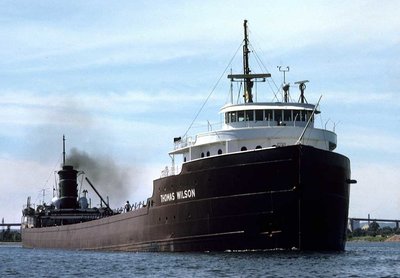
- S/S Thomas Wilson
Today, April 27, 1964, I started my sailing career 53 years ago as a Ordinary Seamen aboard the S/S Thomas Wilson. I am in my 80s now and retired in 1999. There are not to many of us old guys around anymore.
The newer captains of today have no idea the way it was in the 1960s with their 1000 ft ships with accommodations aft and powerful diesel engines. They will never experience sailing a ship built at the turn of the century and only 500 to 620 feet long and 35 telescope sliding hatches with tarps held down by strong backs and batten boards with clamps and tarps frozen with ice and snow. A coal steam engine that the speed was only 8 knts and spewing fly ash all over the deck.. Never get the thrill in a gale with the pilot house forward and the bow hitting a high wave head on and to feel the bow go down in the trough and have the stern come out of the water with the prop shaking the whole ship and the engineer cutting the speed down then when the stern settled down give her full steam ahead and the bow coming up and through a wall of water over the pilot house and freezing all the window with ice and had to put a small heater in the front window so the old man could see out. No tunnels to walk through to get fwd & aft to get to the galley, instead there was a wire cable strung up from the pilot house to the after cabins and a hook up to the cable for the man who wanted to go aft and back fwd. so in a sea he would not get washed off the deck. The galley served fine food and no store bought bread all home made bread, rolls, pie and steak that was 1 1/2 thick. The wheelsmen had to stand and steer by hand and if the wheel was brass his hands would smell of brass. The wheelsmen had to steer by a compass point not a degree. The skipper had a old RCA radar and only used it in fog but was not very good, it took several minutes to make one complete sweep and by that time the target had disappeared until the next sweep. The use of RDF found the ship position and remember the " Cock Hat" ?
Then in later years we got Omega, Decca, Loran -C and now GPS. Weather forecast was announced twice daily at 0700 and 1900 hrs. on AM radios now it is FM, from WMI Lorain and WAS Duluth. I remember Audrey from WAS she was on for years.Now we get weather 24 hours a day and more accurate. And they used to display red pennants and lights for warnings. The buoys were Red & Black, the fog single was 3 distinct blasts from the ship's whistle now it is only one blast. Seamen used to wear cork life jackets, Splicing wire, Use a Polaris, Set up a taffrail Log on the stern for the ship's speed, Maneuvering boards and plastic try angles to plot the true course and speed of ships on radar.
At the Soo Locks we used all four locks and sometimes the Canadian Lock. We had calling in points all along the St. Mary's River and the skipper use to blow the whistle for the lock master and he would single back what lock to use by flashing a series of amber lights. Many times we had to reduce our speed or anchor because of all the traffic. Once in the lock vendors with bikes use to come along side of the ship selling papers, tobacco and candy but not any more. We always had to display the yellow flag with a black dot or inspection flag before we entered the lock. I used to climb up the fwd or aft mast to change the light bulbs and in freezing weather climb up the rear ladder on the pilot house to chip away ice so the scanner would rotate, now they do not do things we had to do. No bow thrusters or twin screws to handle a ship - it was anchors and ship handing.
I am glad to have sailed the way we used to it but I would not mind going for a trip on a 1000 footer and see all the new things they have today.